15 Takeaways
Here are fifteen takeaways from the March 24th event with Dr. Zia Lakdawalla and Rebecca Snow. We've tried to keep things succinct here, but feel free to get in touch using the form above with any questions.
- The iGen Is Different. This generation (1995+) grew up in a world of smartphones, mostly iPhones, and they're growing up more slowly. Less likely to go out without their parents, date, drive, do homework, get jobs. (But also less drinking and other risky behaviour.)
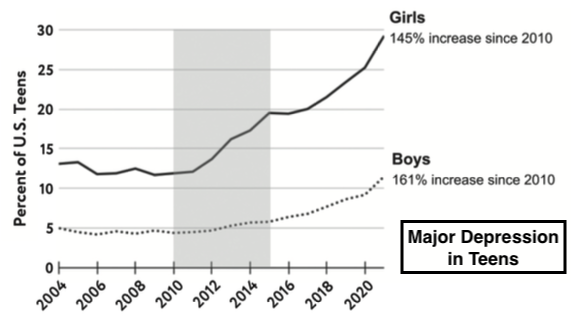
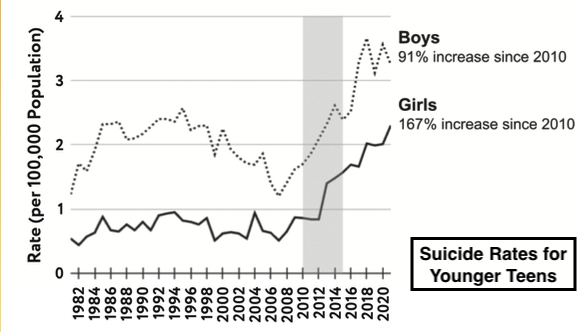
- "As Close to Causation as You Can Get." These two graphs show a complete change of direction right when smartphones became commonplace. Dr. Zia described these graphs "as close to causation as you can get" and it's not surprising; displace healthy childhood activities with isolating, virtual, and downright scary ones and it's hard not to see why this may be happening.
- Six Downsides. Dr. Zia presented six downsides of social media.
- Social deprivation: Evidence shows online life robs from "real life".
- Sleep deprivation: Kids should be getting 9–12 h a night for kids of ages 6–12, or 8–10 h for teens.
- Attention fragmentation: Attention is a muscle that won't be developed when the average teenager gets 237 alerts a day.
- Addiction: The device and many of its apps profit off this; with underdeveloped brains, kids are generally helpless to avoid getting trapped in the cycle.
- Emotion regulation: See #5 on this.
- Compromised attunement: Regularly slices the real-time emotional connection within a family, preventing rich moments of shared joy, grieving, and guidance.
- Dr. Zia's New Tattoo. Dr. Zia shared the graph below of how a "strong feeling" grows and resolves over time. With distractions at hand, that "resolution" stage—coming down from the peak—just doesn't happen. And so one stress ends up piling onto another, and another, and another; or equally bad, kids are terrified of any kind of stress, because they've never build those "resolution" skills.
- The Advantages of Smartphones and Social Media. Kids want smartphones to stay connected to their friends and fit in. But these advantages don't outweigh the many harms, especially when there are other (and better) ways to provide these connection opportunities. This is where collective action—our local community of parents working together—comes in.
- Asking a One-Year-Old to Read. The human brain—especially the frontal lobe—doesn't fully develop until 25. There just isn't the ability to do the decision making, impulse control, risk management, and time management that is required to use tech responsibly. It's like asking a one-year old to read. It's just not a reasonable expectation, and is setting them up to fail.
- Limits Don't Work. Whether technological or other limits, kids will find workarounds. Giving a child a candy bar they love and expecting them to just eat half won't work. They'll find a way! (A high school teacher shared a scary, real-life anecdote of kids in her class using Google Maps as a workaround for unmonitored online chats.)
- The Verdict. How we show up for our kids when they are distressed is everything. Hold off on smartphones until at least 14 and social media till 16+. Good food, good sleep, and good physical activity are essential.
- The Strategy. Kids do what parents do; model what you expect from them. Start conversations about why and how when they're young. Set limits, be consistent, and be predictable. Set screen-free zones for the whole family (e.g., bedrooms, dinner table). And this one was a pleasant surprise: tech etiquette! Talk about how we should always reply to messages from friends, just like we'd reply if they said something to us in person.
- The Alternatives. Want to keep in contact? Use a dumb phone with a no-data plan (We're currently trying out a family dumbphone with a $100 a year infinite talk and text plan.) Want them to listen to music? Get an MP3 player. Also checkout the unpluggedcanada.com website for other product suggestions. Tech has some amazing uses and some junk uses; aim for the products that make the former easier and the latter harder (or impossible).
- Power of Community. This is hard. But it's much less hard when the community—our kids' friends and our own friends—are making similar decisions together. We don't need to wait for new laws or regulations (which will hopefully come) and put our kids at risk in the meantime; we can make collective action.
- Unplugged Canada Has Momentum. The current list of supporters includes the Canadian Medical Association, Ontario Psychiatric Association, the Hospital for Sick Children, and many more. It feels a bit like we're in that gulf between when everyone said cigarettes will kill us, but the laws hadn't kicked in yet and everyone was still smoking. It's time to act now.
- To Read and Watch. Read Jonathan Haidt's "Anxious Generation." Watch "The Social Dilemma" and "Adolescence." Finally, we'll also add this CBC interview with Jonathan Haidt: a fantastic summary of everything—and it's a short one!
- The World is Changing. Australia now has laws around social media for kids (with the tech companies held responsible), and other countries are following suit. But waiting for system-level change is unnecessary; as a community we can change our norms. As of Tuesday, Earl Haig and Earl Beatty had a combined 40 pledges, and the number is growing. Join us in signing the Unplugged Canada pledge here. Let's try and get the Earls to the top of the East End rankings!

Stay in the Loop
Want to stay in the loop around healthy tech use at home and at school in the Earl Haig community? Enter your email below and we'll reach out about any future events or initiatives.